

Gibson, David. The Lord of Psalm 23: Jesus Our Shepherd, Companion, and Host. Wheaton, Ill: Crossway, 2023. ISBN: 978-1-4335-8798-6. $19.99.
Available From (click to access and purchase):
Crossway (the publisher; get 30% off or more by signing up for a free Crossway-plus account)
The Sword and Trowel Bookstore (Midwestern Baptist Theological Seminary)

“The Lord is my shepherd; I shall not want.
He makes me lie down in green pastures.
He leads me beside still waters.
He restores my soul.
He leads me in the paths of righteousness for his name’s sake.” (Psalm 23:1-3 ESV)
Have you ever managed to lose something in plain sight?
For most of us, it’s happened more than once. I’ve desperately looked for my glasses only to discover that they were on my face. I’ve frantically searched for a pen to write with while I was holding one in my hand. And, to top it all, I spent nearly 45 minutes after a service one Sunday morning scouring the sanctuary of the church I serve as pastor to try to find where I had left my Bible only to discover that I had been carrying it around in my hand the entire time…
Familiarity can be both a strength and a weakness. That which is most familiar to us resonates deeply within our hearts, minds, and souls. And yet, that which is most familiar to us can also be overlooked or taken for granted.
Tragically, I fear that this has been the treatment applied by many to the 23rd Psalm. Psalm 23, among the best-known and most beloved passages in all of Scripture, is familiar to nearly all Christians. And yet, despite its broad familiarity, it seems to be rarely preached, taught, or read in a manner befitting the beauty, power, and scope of the truth it conveys. Like the familiar object lost in plain sight, we often read the familiar words of this dearly loved passage without pausing to reflect on the full meaning of what is being said to us in its six magnificent verses. In The Lord of Psalm 23: Jesus our Shepherd, Companion, and Host, David Gibson sets out to rectify this unfortunate tendency.
Overview:
The Lord of Psalm 23 is an insightful, moving, and refreshing exposition of the 23rd Psalm. Perhaps one of the best-known passages in all of Scripture, Psalm 23 is a Davidic Psalm often quoted in the context of funerals, sympathy and encouragement cards, and a host of other contexts in which individuals seek to convey words of strength, comfort, and assurance. While appropriate to all of these contexts, David Gibson reveals that the 23rd Psalm is marked by tremendous theological depth and beauty that often remains untapped in the superficial use and treatment of this breathtaking passage of Scripture.
Authorship and Qualifications:
The Lord of Psalm 23 was written by Dr. David Gibson. Dr. Gibson currently serves as Minister of Trinity Church in Aberdeen, Scotland, a congregation of the International Presbyterian Church.[1] Previously he served as a staff worker for the Religious and Theological Studies Fellowship (part of the Universities and Colleges Christian Fellowship, or UCCF) and as an assistant minister at High Church, Hilton, Aberdeen.[2] Dr. Gibson is the editor or author of several works, including From Heaven He Came and Sought Her, Living Life Backward: How Ecclesiastes Teaches Us to Live in Light of the End, and Radically Whole: Gospel Healing for the Divided Heart.[3]Dr. Gibson earned his Doctor of Philosophy (Ph.D.) degree in theology from the University of Aberdeen in Aberdeen, Scotland.[4]
Materials and Construction:
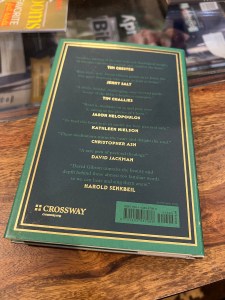
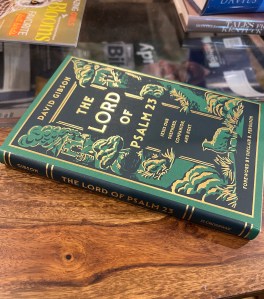
The general quality of the materials and construction of the book is impressive. The book is hardback, with an attractive green and gold dust jacket. The dust jacket features a general theme of green hues with various shades used to provide imagery of shepherds, the countryside, and, consistent with the theme of both the 23rd Psalm and the book itself, a sheep at the bottom center of the cover. In addition to the varying shades of green, a gold emboss provides the book’s title, the author’s and reviewers’ names (front and back cover), and highlights on the imagery included on the dust jacket. The combination of rich green hues and gold embossing conveys a warm and inviting, yet profoundly dignified, presentation befitting the power and truth reflected in the book’s content. The binding of the work also appears to be Smyth-sewn, providing a durable construction that will endure for years to come. The paper used also has a good thickness with minimal ghosting that facilitates a quality reading experience.
Survey of Contents and Critical Evaluation:
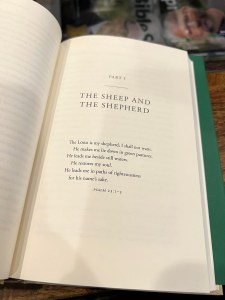
The Lord of Psalm 23 provides a verse-by-verse expository treatment of the entirety of the 23rd Psalm. The exposition, based on sermons previously delivered by Gibson, is presented in the form of three depictions of the Christian’s union with Christ. The first depicts the relationship between believers and Christ as “The Sheep and the Shepherd” (Part 1, 11-58), while the second depicts the relationship according to “The Traveler and the Companion” (Part 2, 59-104). The final depiction invokes the metaphor of hospitality between “The Guest and the Host” (Part 3, 105-146).
The exposition reflected in part 1, “The Sheep and the Shepherd,” is organized according to “Who He Is” (11-24), “What He Provides” (25-40), and “Where He Leads” (41-58). Part 2, “The Traveler and the Companion,” is structured according to “How He Leads” (59-72), “Where He Is” (73-88), and “What He Holds” (89-104). Finally, part 3, “The Guest and the Host,” examines “How He Welcomes” (105-120), “What He Sends” (121-134), and “Where He Invites” (135-146). After the acknowledgments towards the end of the work, the book also provides a general index (149-154) and a Scripture index (155-157).
In explaining the work’s structure, Gibson noted that he utilized an outline previously articulated for the 23rd Psalm by Alec Motyer in The New Bible Commentary (4). The three major parts of the book are based on Motyer’s outline for the Psalm and compose what Gibson called the “skeleton” of the exposition. However, he also observed that the thread running throughout the exposition – the relationship between believers and the risen Lord – forms its “spine.” “If these portions of the psalm make up its skeletal structure, then the spine of the psalm is the close, deeply personal relationship between its author and the person it describes” (4). Gibson further observed, “this means that this psalm is in our Bibles as an exquisite depiction of the Lord Jesus Christ” (4).
Gibson’s verse-by-verse exposition of Psalm 23 reflects both skilled and able exposition of the Scriptures by a Ph.D. in theology, as well as the deeply moving and soul-nourishing practical application of a seasoned pastor. For example, early in his discussion of the first verse of Psalm 23, Gibson provides a well-informed yet accessible explanation of David’s use of the personal name of God, “יְהוָ֥ה” (typically transliterated as “YHWH” or “Yahweh”)[5]. In most English translations, the word יְהוָ֥ה is translated as “LORD” (in all capital letters). Gibson’s explanation of the significance of the word, as the personal and covenant name of God, to our understanding of Psalm 23 brilliantly reflects his advanced scholarly training and his pastoral sensitivity. As Gibson summarized,
“I tell the Trinity Church family often that the best thing I can ever give them from the pulpit is a clearer sight of God himself and that the greatest thing they can ever have in life is more of God himself. We always want practical religion – effective habits, daily disciplines, lifestyle fixes – and these can all be wonderful if they are full of gospel grace, but the fountain from which they flow is God himself. Whoever you are, and whatever you are experiencing today as you read these lines, there is nothing better to know in all the world than that the shepherd you belong to is the Lord of the burning bush who revealed his name to Moses” (15).
Later in the work, when examining the nature of the “rod” and the “staff” in verse 4, Gibson further observed,
“The rod helps us to know, as John Goldingray says, that having the Lord ‘with’ us ‘is not merely a feeling. It does not signify mere presence but also action…This presence expresses itself by aggressive action to defeat enemies and thus protect the one to whom Yhwh is committed.’ Defeating enemies and protecting sheep: both of these are present in the shepherding work of the Lord Jesus for us. ‘My sheep hear my voice and I know them, and they follow me. I give them eternal life, and they will never perish, and no one will snatch them out of my hand’ (John 10:28). Such language implies, of course, that some will attempt to snatch, that there are forces out there who seek to do sheep harm, and yet we are encased in the shepherd’s strong hand, which is in turn grasped in the Father’s strong hand (John 10:29). This ready willingness to protect his sheep follows from the fact that Jesus knows exactly who belongs to him. He ‘calls his own sheep by name and leads them out. When he has brought out all his own, he goes before them, and the sheep follow him, for they know his voice’ (John 10:3-4). Numbered by Jesus, we are led by Jesus; led by Jesus, we are protected by Jesus; and protected by Jesus, we are comforted by Jesus” (92-93).

Such an application of the rod imagery is both accurate and powerful unto itself, but with the tender heart of a faithful pastor, Gibson takes his exposition a step further. Recognizing the inevitable difficulties of life in a fallen world, Gibson speaks clearly and compassionately to those struggling to realize the full power of what Psalm 23 is saying to us in verse 4:
“Some of us reading these lines feel very weak. The circumstances of life have pressed us down, and we feel pretty broken. This shepherd, God’s servant, will not break a bruised reed or snuff out a smoldering wick (Matt. 12:20, citing Isa. 42:3); he is tender to all our brokenness. But this same Jesus ‘will faithfully bring forth justice” (Isa. 42:3; Matt. 12:20). So let the rod in Jesus’s hand also put strength into your failing heart; for, remember, he is leading you through the valley, and on the other side is the house of the Lord where we will dwell forever. We should always remember how the Bible ends: on the other side of it all the Lamb wins. The Lamb wins because he is also a Lion. We should never mistake the tenderness of our shepherd for weakness, or his care for us for carelessness about all that threatens us” (93).
What a convicting, restoring, and victorious reminder for the weary, the broken, and the hurting! Such a moving appropriation of theological truth to the struggles we face as Christians in a sinful, fallen world is worthy of careful consideration and celebration unto itself. However, in supporting these points and others throughout the work, Gibson interacts with an array of scholarly sources that are also important to note. Throughout his exposition, Gibson appeals to both pastoral and scholarly source material, including commentaries, sermons, popular and scholarly treatments of the 23rd Psalm in books and other publications, and systematic and historical theologies. Gibson’s source material encompasses contemporary works, as well as theological voices representing the span of Christian history. The same author who cites the contemporary works of Joel R. Beeke, Michael Horton, and John Piper also appeals to the work of Athanasius, John Calvin, and C. H. Spurgeon throughout his examination of Psalm 23. Accordingly, the book reflects a mature and well-informed theological balance of source interactions, not only between the practical and the scholarly but also between the contemporary and the historical, across a range of denominations.
Summary and Recommendation:
Dr. Gibson’s thesis is that Psalm 23 is an exquisite depiction of the Lord Jesus Christ and His relationship with His people. In support of this thesis, Dr. Gibson marshaled both an array of resources and his able expositional and theological skill to provide an examination of the 23rd Psalm that not only confirms that thesis in a manner reflecting extraordinary depth and beauty, but also enables Christian readers to find in it renewed strength and rekindled adoration of the risen Lord as our Shepherd, Companion, and Host. At the outset of the work, Gibson stated that his “simple prayer for this book, in the words of William Gadsby’s hymn of praise to the Lord Jesus, is that through its pages your ‘soul could love and praise him more.’” (7). For this reader, his prayer was certainly answered.
This work is to be commended to any Christian seeking a deeper understanding of Psalm 23 and, most importantly, the gracious and glorious, powerful and merciful, majestic and meek Lord of that Psalm.
“Even when I go through the darkest valley,
I fear no danger,
for you are with me;
your rod and your staff—they comfort me.
5 You prepare a table before me
in the presence of my enemies;
you anoint my head with oil;
my cup overflows.
6 Only goodness and faithful love will pursue me
all the days of my life,
and I will dwell in the house of the Lord
as long as I live.”
-Psalm 23:4-6 (CSB)
*Author’s note: I received a copy of this book from Crossway in exchange for an honest review.
[1] Trinity Church Aberdeen, “Who,” trinityaberdeen.org, https://trinityaberdeen.org.uk/who/
[2] 10ofthose.com, “David Gibson,” Authors, 10ofthose.com, https://uk.10ofthose.com/authors/602/david-gibson
[3] Crossway, “David Gibson,” Authors, Crossway.org, https://www.crossway.org/authors/david-gibson/
[4] Christian Focus, “David Gibson,” Contributors, christianfocus.com, https://www.christianfocus.com/contributors/726/david-gibson
[5] K. Elliger, W. Rudolph, and Gérard E. Weil, Biblia Hebraica Stuttgartensia, electronic ed. (Stuttgart: German Bible Society, 2003), Ps 23:1.
 Preacher Talk
wow!! 22Resource Review: “Interpreting Scripture with the Great Tradition: Recovering the Genius of Premodern Exegesis” by Craig Carter
LikeLike